
You’re posting on social media, running ads, improving your website, and trying different marketing ideas. But the results still don’t match the effort. Traffic stays low, leads are inconsistent, or sales do not move.
When this happens, the answer is not always to spend more. Often, the bigger issue is how the marketing is planned, targeted, measured, or connected.
In this guide, we’ll break down 7 common digital marketing mistakes, explain why they happen, and give you a practical fix for each one.
Key idea: More activity does not automatically mean better results. Your strategy, audience, content, website, campaigns, and measurement need to work together.
1. Starting Without a Clear Digital Marketing Strategy
Where the Strategy Goes Wrong
The problem starts when businesses choose tactics before deciding what they want marketing to achieve. Every activity should have a clear purpose and support a specific business goal.
Many businesses start with tactics instead of a plan. They post because they feel they should, run ads because competitors are running ads, or publish content without a clear purpose.

Why Businesses Lose Direction
Without a clear direction, teams often jump between platforms and tactics. This creates activity without a consistent way to judge whether the work is moving the business forward.
Without a direction, the work becomes scattered. It is also difficult to know whether the marketing is actually helping the business.
Building a Clearer Marketing Plan
Set one main goal, define the audience, choose suitable channels, and decide how success will be measured. Keep the plan simple enough for the team to follow consistently.
Start with one clear goal, such as generating qualified leads, increasing sales, or getting more local enquiries. Then choose the channels and activities that directly support that goal. A simple plan is better than ten disconnected tactics.
2. Targeting the Wrong Audience
The Audience Problem
Reaching more people does not always mean reaching better customers. Broad messaging can attract attention from people who have little interest in the product, service, or offer.
Even good marketing can fail when it reaches people who are unlikely to buy. Broad targeting may produce views and clicks, but those numbers mean little if the audience is not a good fit.

What Leads to Poor Targeting
Poor targeting often comes from assumptions about customers. Search behaviour, existing customers, enquiries, and common questions can provide better clues about who the business should reach.
The problem often starts with an unclear customer profile. You need to understand who needs your offer, what problem they are trying to solve, and what they care about before choosing your message.
Finding and Reaching the Right Customers
Build a clear customer profile and use it when creating content, ads, landing pages, and offers. Specific messaging usually makes it easier for the right audience to understand the value.
Review existing customers, sales conversations, search queries, and website behaviour. Use those insights to make your content, ads, and landing pages more specific.
3. Focusing on Traffic Instead of Business Results
When Traffic Isn’t Enough
Website traffic matters, but visitor numbers alone do not show business success. The quality and relevance of that traffic are important when the goal is enquiries, bookings, or sales.
More visitors sound good, but traffic alone does not pay the bills. A website can get visitors and still generate very few enquiries or sales.

What Happens After the Click
A visitor still needs a clear path after arriving. If the page is confusing, slow, or unrelated to the original message, the visitor may leave before taking the desired action.
The missing piece is often what happens after the click. Visitors may land on a page that is unclear, slow, poorly matched to the campaign, or missing an obvious next step.
Turning Traffic Into Measurable Results
Define valuable actions such as calls, forms, purchases, or bookings. Then compare traffic sources by the results they produce, rather than judging performance only by visitor volume.
Track meaningful actions such as calls, forms, purchases, bookings, or qualified enquiries. Ask not only “How much traffic did we get?” but also “What did that traffic produce?”
4. Treating SEO as Only a Keyword Exercise
Why Keywords Alone Aren’t Enough
Keywords help identify searches, but useful SEO also depends on content quality, search intent, page structure, internal links, and the overall experience provided to the visitor.
Adding keywords to a page does not automatically make the page useful. People want clear answers and content that matches what they are actually searching for.

Where the SEO Approach Falls Short
A page can use the right keyword and still miss the searcher’s needs. The content should answer the actual question or support the action the visitor expects to take.
A page can mention a keyword several times and still miss the search intent. It may also have weak structure, poor internal links, or information that does not help the visitor move forward.
Building a More Complete SEO Strategy
Combine keyword research with intent analysis, useful content, technical improvements, internal linking, and regular performance reviews. This creates a more complete approach than keyword placement alone.
Use SEO and digital marketing together. Understand the search intent, create useful content, improve page structure, add relevant internal links, and give visitors a clear next step.
5. Running Paid Ads Without Proper Tracking
The Tracking Gap
Clicks and impressions show activity, but they do not explain the final business result. Reliable tracking helps identify whether campaigns are producing useful enquiries, purchases, or other conversions.
Paid ads can bring clicks quickly, but without reliable tracking you may not know whether those clicks are producing useful results.

Why Ad Performance Can Be Misleading
A campaign can generate inexpensive clicks without producing valuable results. Looking beyond clicks helps reveal which campaigns are actually supporting the business objective.
Businesses sometimes judge campaigns mainly by impressions and clicks. That can hide the difference between activity and actual business value.
Measuring What Actually Matters
Decide what counts as a conversion before launching a campaign. Check that those actions are recorded correctly, then use the data to guide future campaign improvements.
Define the conversion before launching or scaling a campaign. Check that important actions are recorded correctly, then review performance beyond the initial click.
6. Using Too Many Marketing Channels Without a Plan
The Problem With Being Everywhere
Managing every platform at once can spread a small team’s time too thin. The result may be inconsistent content, limited testing, and less attention on the channels that matter most.
Trying to be everywhere can create a lot of work without creating much progress. A small team may attempt SEO, Instagram, LinkedIn, email, Google Ads, Meta Ads, YouTube, and more at the same time.

Why Spreading Resources Hurts Results
Each channel needs planning, content, monitoring, and measurement. Concentrating resources on relevant channels can make the overall marketing process easier to manage and improve.
Every channel needs the right content, audience, time, and measurement. Spreading resources too thin can make every channel average.
Choosing the Right Marketing Channels
Choose channels based on where your audience searches, learns, compares, or makes decisions. Build a reliable process there before adding more platforms.
Choose the channels where your customers actually spend time and make decisions. Build a repeatable process there first. Add another channel when you have the resources to manage it properly.
7. Not Reviewing and Improving Performance
When Marketing Becomes Set-and-Forget
Digital marketing changes as audiences, competitors, platforms, and offers change. A strategy should therefore be reviewed instead of being left unchanged for long periods.
Marketing is not a set-it-and-forget-it task. What works today may need to change as your audience, competition, offer, or market changes.

Why Regular Review Matters
Regular reviews help identify what is improving, what is declining, and what needs attention. The goal is not to change everything, but to make informed adjustments.
Some businesses keep repeating the same activity because they have already invested time in it. Others collect reports but never turn the findings into action.
Turning Performance Data Into Action
Create a monthly or quarterly review routine. Turn important findings into specific actions, then check the next results to see whether those changes are helping.
Set a regular review cycle. Keep what works, improve what is weak, and stop activities that consistently fail to support the goal. The strongest digital marketing strategies are improved over time.
How to Build a Better Digital Marketing Strategy
You do not need a complicated plan. Start with a simple process and improve it as you learn what your audience responds to.
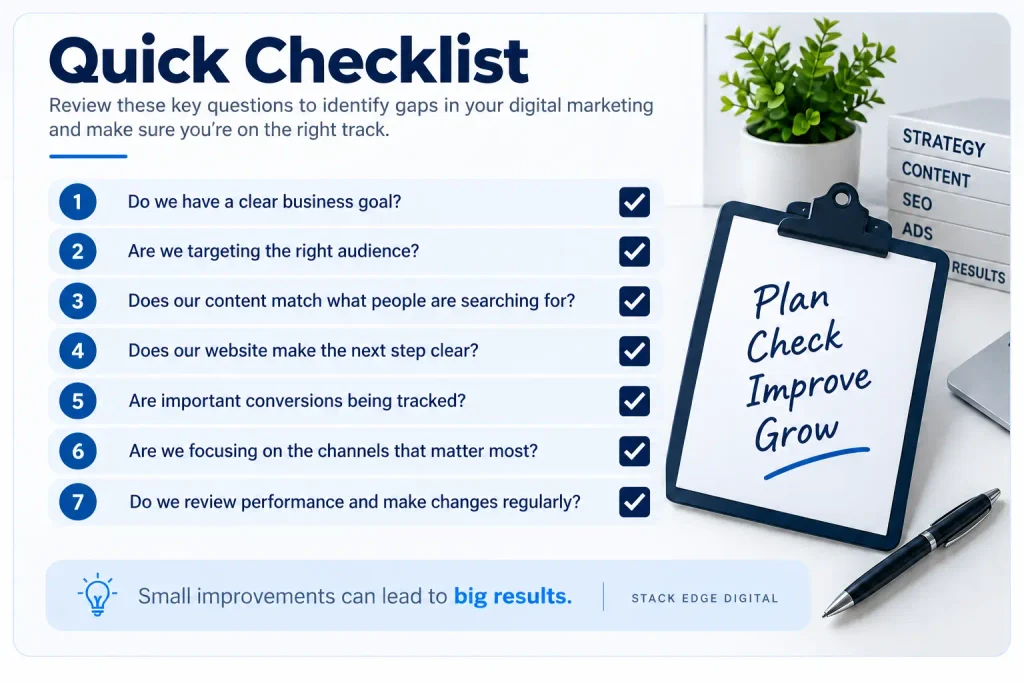
- Set one clear business goal.
- Define the audience and the problem you want to solve.
- Choose the few channels that fit that audience.
- Create content around real customer needs and searches.
- Make sure the website or landing page supports the desired action.
- Track meaningful conversions, not just visits and views.
- Review the numbers and make one clear improvement at a time.
Digital Marketing Mistakes: Quick Checklist
Frequently Asked Questions
What are the most common digital marketing mistakes?
The most common mistakes include unclear goals, wrong audience targeting, focusing only on traffic, weak SEO strategy, poor ad tracking, using too many channels, and failing to review performance.
What are effective digital marketing strategies?
Effective strategies connect a clear business goal with the right audience, useful content, search visibility, relevant campaigns, a strong website experience, and measurable actions.
What are digital marketing solutions?
Digital marketing solutions are practical activities used to solve online growth problems. Depending on the business, they can include SEO, content, social media, paid advertising, conversion improvements, and analytics.
What is the role of SEO in digital marketing?
SEO helps businesses become easier to find when people search for relevant products, services, or information. It can also provide useful insights for content and website decisions.
How do SEO and digital marketing work together?
SEO supports organic visibility and helps reveal what people are searching for. Those insights can inform content, paid campaigns, website improvements, and broader marketing decisions.
How can a small business improve its digital marketing?
Start with one goal, understand the target customer, focus on a few useful channels, improve the website experience, track meaningful actions, and keep improving based on results.